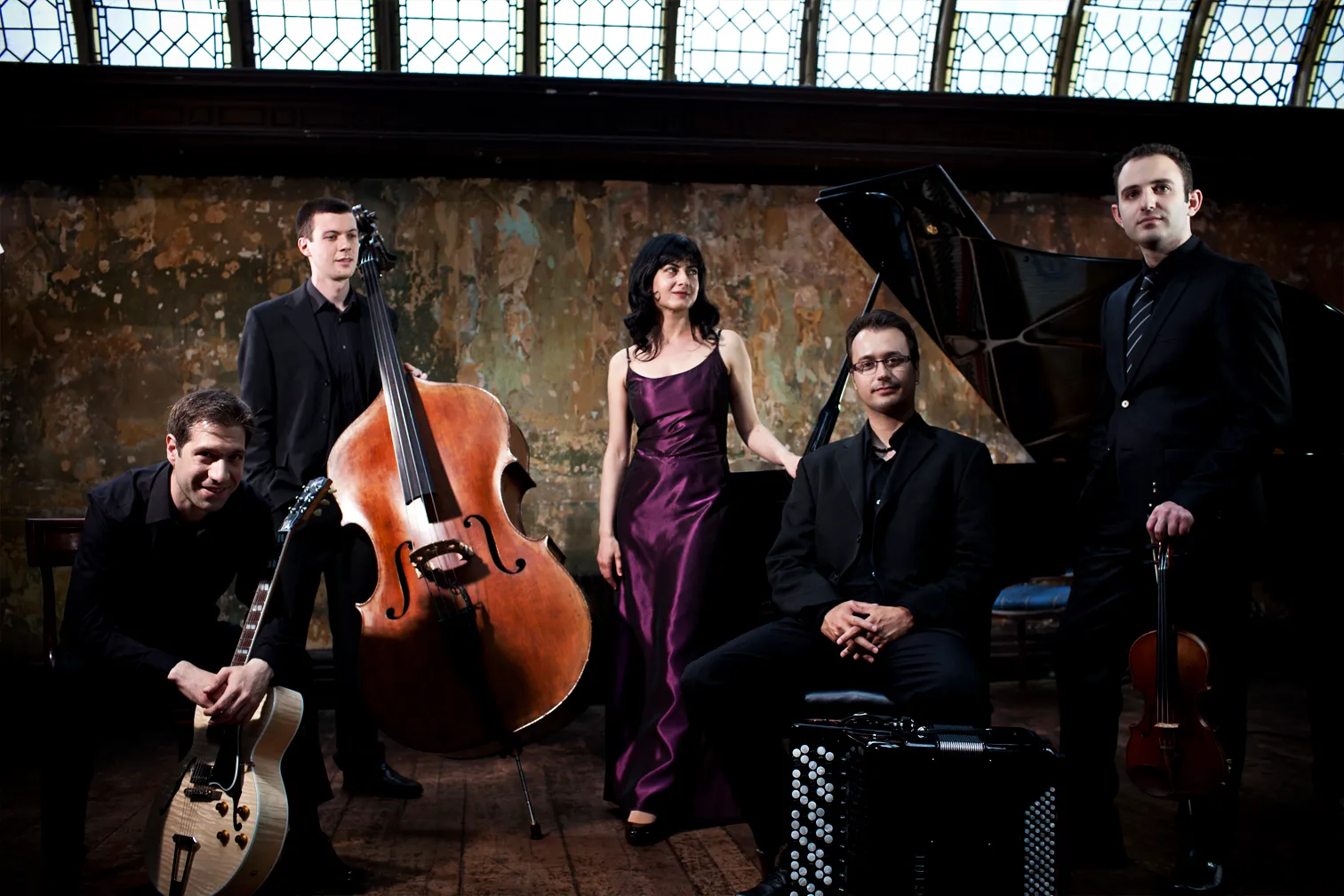
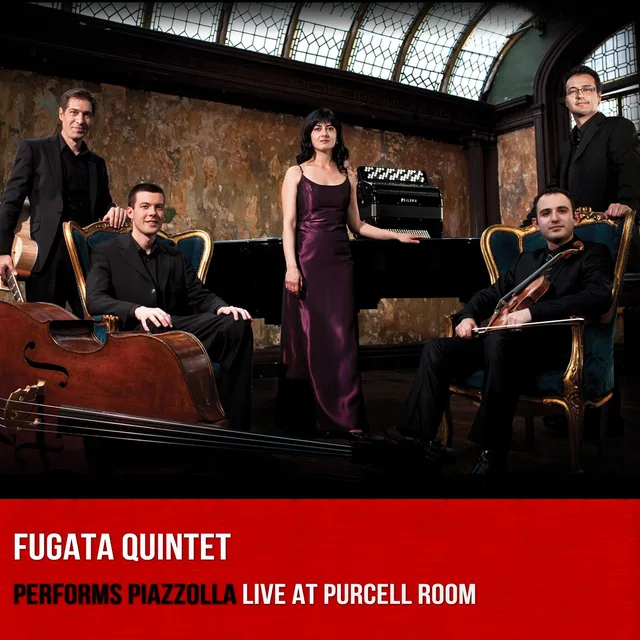
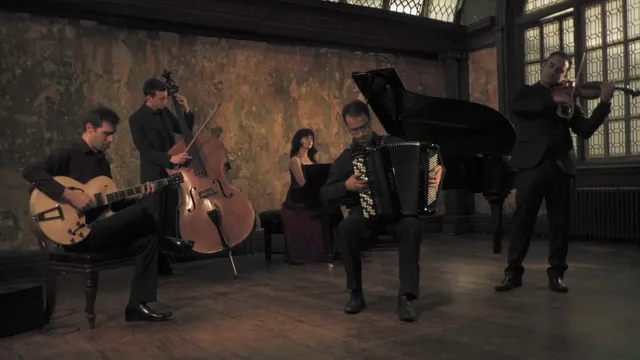
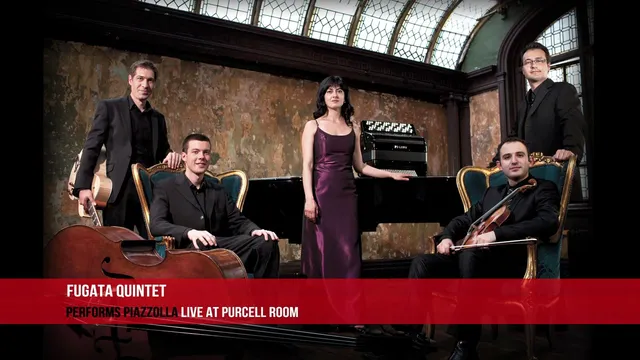
Fugata Quintet Performs Piazzolla Live at Purcell Room
These notes introduce the works heard in Fugata Quintet’s live Purcell Room album: a concentrated portrait of Piazzolla’s quintet writing, its theatrical energy, contrapuntal discipline, lyric intensity, and the particular sound-world of nuevo tango.
Concierto para Quinteto
Piazzolla formed two quintets during his career: the first active from 1960 to 1974, the second from 1978 to 1988. Critics have often debated which ensemble was superior, though Piazzolla himself never admitted to a favourite. Concierto para Quinteto was composed in honour of the musicians who joined him in forming the first quintet.
Those musicians represented a mosaic of Buenos Aires musical life. The violinist Antonio Agri came from the classical world of the Rosario Symphony; the guitarist Horacio Malvicino was a well-known jazz musician; and both the pianist Osvaldo Manzi and the bassist Kicho Díaz were tangueros from traditional tango orchestras.
The work was first heard in 1970 with the first quintet, but was later performed and recorded by both of Piazzolla’s quintets. It is an excellent introduction to his quintet language: percussive instrumental writing, harmonic blocks, contrapuntal construction, and themes passed between instruments as part of a unified whole rather than as a succession of accompanied solos.
The guitar is treated as a full melodic voice rather than merely as rhythmic accompaniment, while the tango influence is present in more subtle ways, not least in the slow rhythmic pattern of the bass line in the second section.
Escualo
Escualo, composed in 1979 for the second quintet, is among Piazzolla’s most rhythmically demanding pieces and has long been admired by jazz musicians. Piazzolla gave a copy of the newly completed score to his violinist Fernando Suárez Paz just as the latter was leaving for a week-long family holiday. On returning, Suárez Paz complained that the holiday had been ruined: he had spent the entire time working out the rhythms and bowing patterns.
The final flourish remains both feared and revered by violinists. The title is the Spanish word for shark, a reference to Piazzolla’s love of shark fishing.
Retrato de Milton
Piazzolla composed three Retratos, or portraits. The first, Retrato de Alfredo Gobbi, paid tribute to the tango composer and violinist whom Piazzolla regarded as a bridge between traditional tango and nuevo tango. The second was a self-portrait, Retrato de mi mismo.
In 1972 Piazzolla met the young Brazilian musician Milton Nascimento and was sufficiently impressed to transform his earlier self-portrait into a portrait of Milton. Nascimento went on to a distinguished career as a singer-songwriter and jazz musician in Brazil. He is the only living musician honoured in the title of a Piazzolla composition.
Mumuki
Composed in 1984, Mumuki is a tribute to Piazzolla’s second wife, Laura, whom he often called by that affectionate name. Unusually, the piece opens with a lyrical guitar solo, establishing the theme of one of Piazzolla’s most beautiful works.
Shortly before the stroke that incapacitated him, Piazzolla was asked to name his favourite pieces. Mumuki appeared on his short list of six. The bandoneon does not enter until the midpoint of the piece: a revealing detail, suggesting the value Piazzolla placed on the music itself rather than on his own instrumental presence within it.
Adiós Nonino
Adiós Nonino was composed in October 1959 after the death of Piazzolla’s father, whom his grandchildren called Nonino, or “little grandfather”. On hearing of his father’s death, he shut himself in the kitchen of the family’s small New York apartment and slowly played an earlier theme, interspersing it with elegiac passages shaped by his grief.
The result became Adiós Nonino, a work Piazzolla regarded as his most important composition. It was the piece he performed most often during his career and the last work he publicly played before his death in 1992.
Verano Porteño and Invierno Porteño
The pairing of Piazzolla’s and Vivaldi’s seasons has become familiar, especially through the advocacy of Gidon Kremer and Kremerata Baltica. Yet Piazzolla’s Estaciones Porteñas were not conceived as a suite in the manner of Vivaldi’s Four Seasons.
Verano Porteño, the first of the four, was composed in a single overnight session in 1965. Otoño Porteño followed five years later, then Primavera Porteña and Invierno Porteño. It seems to have occurred to Piazzolla only later that one further season would complete the cycle and invite comparison with Vivaldi.
La Muerte del Ángel
Piazzolla wrote five works known collectively as the angel series, though, like the seasons, they were not originally conceived as a single suite. In 1962 Alberto Rodríguez Muñoz commissioned angel pieces for his play El Tango del Ángel, for which Piazzolla supplied Introducción al Ángel and La Muerte del Ángel.
La Muerte del Ángel was intended to accompany the moment at which an angel is sacrificed to save humanity. Ironically, it became one of Piazzolla’s most popular works. It opens with a brilliant four-part fugue, whose subject returns near the end and again in the coda before the music fades into a dissonant piano sonority.
Romance del Diablo and Vayamos al Diablo
Unlike the angel pieces, Piazzolla’s devil series is rarely heard. The three works were composed as a suite in 1965 for a quintet performance at Philharmonic Hall in New York, intended to balance the evening’s programme: evil set against good.
Romance del Diablo is more romantic than devilish, one of Piazzolla’s more lyrical inspirations. Vayamos al Diablo sets an insistent, manic rhythm, the music chasing itself in relentless circles with a touch of the diabolus in musica: musical hell, indeed.
Tangata “Silfo y Ondina”
Unlike the seasons and the angel pieces, Tangata “Silfo y Ondina” was composed as a suite, though its movements are often performed separately. The original Tangata, composed in 1968, consisted of three movements: Fugata, Soledad, and Final. A fourth work, Coral, was composed around the same period and sits naturally alongside them.
The title Tangata is a neologism created by Piazzolla from tango and sonata. “Silfo y Ondina” refers to two spirits: Sylph, spirit of air, and Ondine, spirit of water. Fugata begins with a concise four-voice fugue before transforming into something closer to a theatrical opening number; Soledad is sombre and inward; Final is a sequence of vignettes, almost a sampler of Piazzolla’s styles.
← Back to Fugata Quintet Performs Piazzolla Live at Purcell Room
 Buenos Aires — London